Ebook Download The End of Time: The Next Revolution in Our Understanding of the Universe, by Julian B. Barbour
It is not secret when attaching the writing abilities to reading. Checking out The End Of Time: The Next Revolution In Our Understanding Of The Universe, By Julian B. Barbour will certainly make you obtain more resources and also resources. It is a manner in which can improve just how you neglect and also comprehend the life. By reading this The End Of Time: The Next Revolution In Our Understanding Of The Universe, By Julian B. Barbour, you could more than just what you obtain from other publication The End Of Time: The Next Revolution In Our Understanding Of The Universe, By Julian B. Barbour This is a prominent publication that is published from famous author. Seen kind the writer, it can be relied on that this book The End Of Time: The Next Revolution In Our Understanding Of The Universe, By Julian B. Barbour will give numerous motivations, regarding the life as well as experience as well as every little thing inside.
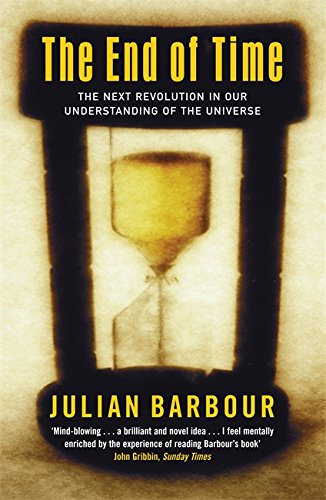
The End of Time: The Next Revolution in Our Understanding of the Universe, by Julian B. Barbour

Ebook Download The End of Time: The Next Revolution in Our Understanding of the Universe, by Julian B. Barbour
Some people might be laughing when checking out you reviewing The End Of Time: The Next Revolution In Our Understanding Of The Universe, By Julian B. Barbour in your spare time. Some might be admired of you. And also some could want resemble you which have reading pastime. Exactly what about your personal feeling? Have you felt right? Reading The End Of Time: The Next Revolution In Our Understanding Of The Universe, By Julian B. Barbour is a requirement and also a pastime at once. This problem is the on that particular will certainly make you really feel that you need to read. If you recognize are looking for the book entitled The End Of Time: The Next Revolution In Our Understanding Of The Universe, By Julian B. Barbour as the selection of reading, you could discover right here.
Why need to be this e-book The End Of Time: The Next Revolution In Our Understanding Of The Universe, By Julian B. Barbour to review? You will never ever get the knowledge and also encounter without obtaining by yourself there or attempting by yourself to do it. Hence, reviewing this e-book The End Of Time: The Next Revolution In Our Understanding Of The Universe, By Julian B. Barbour is needed. You could be fine and proper enough to get just how vital is reviewing this The End Of Time: The Next Revolution In Our Understanding Of The Universe, By Julian B. Barbour Also you consistently read by commitment, you could sustain yourself to have reading e-book routine. It will be so valuable and also fun then.
But, how is the way to obtain this publication The End Of Time: The Next Revolution In Our Understanding Of The Universe, By Julian B. Barbour Still puzzled? It matters not. You could appreciate reading this e-book The End Of Time: The Next Revolution In Our Understanding Of The Universe, By Julian B. Barbour by on-line or soft file. Merely download the publication The End Of Time: The Next Revolution In Our Understanding Of The Universe, By Julian B. Barbour in the web link offered to see. You will certainly get this The End Of Time: The Next Revolution In Our Understanding Of The Universe, By Julian B. Barbour by online. After downloading, you could conserve the soft data in your computer system or kitchen appliance. So, it will certainly ease you to review this publication The End Of Time: The Next Revolution In Our Understanding Of The Universe, By Julian B. Barbour in specific time or place. It might be not yes to enjoy reading this e-book The End Of Time: The Next Revolution In Our Understanding Of The Universe, By Julian B. Barbour, because you have whole lots of job. However, with this soft data, you could take pleasure in checking out in the spare time also in the gaps of your tasks in workplace.
Once again, reviewing habit will always provide helpful advantages for you. You might not have to spend several times to check out guide The End Of Time: The Next Revolution In Our Understanding Of The Universe, By Julian B. Barbour Simply set apart numerous times in our extra or downtimes while having dish or in your office to review. This The End Of Time: The Next Revolution In Our Understanding Of The Universe, By Julian B. Barbour will show you new point that you can do now. It will help you to improve the high quality of your life. Occasion it is simply an enjoyable book The End Of Time: The Next Revolution In Our Understanding Of The Universe, By Julian B. Barbour, you can be happier as well as more fun to delight in reading.
Time is an illusion. Although the laws of physics create a powerful impression that time is flowing, in fact there are only timeless 'nows'. In THE END OF TIME, the British theoretical physicist Julian Barbour describes the coming revolution in our understanding of the world: a quantum theory of the universe that brings together Einstein's general theory of relativity, which denies the existence of a unique time, and quantum mechanics, which demands one. Barbour believes that only the most radical of ideas can resolve the conflict between these two theories: that there is, quite literally, no time at all. This is the first full-length account of the crisis in our understanding that has enveloped quantum cosmology. Unifying thinking that has never been brought together before in a book for the general reader, Barbour reveals the true architecture of the universe and demonstrates how physics is coming up sharp against the extraordinary possibility that the sense of time passing emerges from a universe that is timeless. The heart of the book is the author's lucid description of how a world of stillness can appear to be teeming with motion: in this timeless world where all possible instants coexist, complex mathematical rules of quantum mechanics bind together a special selection of these instants in a coherent order that consciousness perceives as the flow of time. Finally, in a lucid and eloquent epilogue, the author speculates on the philosophical implications of his theory: Does free will exist? Is time travel possible? How did the universe begin? Where is heaven? Does the denial of time make life meaningless? Written with exceptional clarity and elegance, this profound and original work presents a dazzlingly powerful argument that all will be able to follow, but no-one with an interest in the workings of the universe will be able to ignore.
- Sales Rank: #1920176 in Books
- Published on: 2000-03-16
- Original language: English
- Number of items: 1
- Dimensions: 7.76" h x .94" w x 5.12" l, .55 pounds
- Binding: Paperback
- 384 pages
About the Author
Julian Barbour has worked on foundational issues in physics for 35 years, making important and original contributions to the theory of time and motion. Author of Absolute or Relative Motion?, a much-praised book on the history of science, he has contributed to several recent major television and radio programmes that have been broadcast worldwide. He is exceptional in having a leading reputation in the field while holding no academic position.
Most helpful customer reviews
11 of 12 people found the following review helpful.
Seeds of a work beyond our Time
By Ali M.
I'm not a physicist by profession though I conduct my own general inquiries into foundational issues of mathematical physics. I have read this book and I am deeply impressed and intrigued by the whole wealth of ideas and research works used by Julian to formulate his key concepts. As I read about Julian's life I find him a very committed scientist to probe deeper issues. While this book avoids explicit use of mathematical equations nevertheless, one needs to do a background study on his referenced papers in order to understand arguing grounds of this book.
There is only Quantum Statics! This is the key concept (and also mathematically argued) main theme of this book as Julian himself puts this on 2nd paragraph of page 253.
Now in my view this goes against all the impressions and ideas we have from what is generally considered as changing/temporal universe. It is so obvious that all is about motion and change and (almost) all formulations of general relativity and quantum mechanics do involve a time coordinate in order to capture this so basic observation, rate of change!
This is where Julian goes beyond or (deeper into) generally introduced framework of physics and attempts to introduce a Machian formulation of general relativity to probe into roots of (apparent) conflict among unification efforts of Quantum Mechanics with General Relativity: introduce a space of all possible relative configurations, called Platonia, which contains all possible relative configurations of everything that could ever exist(I'm adding some bits of my own wording here) and try to employ intriguing concepts/tools like `Best Matching' and `Machian Distinguished Simplifier' to trace how a notion of change comes into our ordinary formulation of dynamics. I consider these as requisites to grasp this book. Julian uses simple examples to convey his concepts.
As much as I understand Julian's works, it could be the implications of ideas are so powerful that if understood properly and imagined for their repercussions, they would open a door to a new view of workings of universe, reconciliation of classical field theories is one of them plus hint at deeper imports of gauge fields as derivative of Best Matching (expert readers may refer to Bruno Bertotti's papers in this regard).
I would rather not make any philosophical conclusions for the message that our universe is actually is static universe but I would encourage those readers of Heidegger's works in phenomenology of time and being to match Julian's ideas with Martin Heidegger's open ended inquiries.
I would recommend this book to anyone interested in nature of time; there are many other books written on the subject but this one is an exception. As for me it helped me with better understanding of classical dynamics.
Alireza
8 of 10 people found the following review helpful.
not for the layperson
By Stephen P. Kennedy
I purchased this book because it was advertised as being readable even by a layperson (someone not particular scientifically literate). My impression after reading the book is that you will not get much out of it unless you have a strong scientific background. I would like to hear from others who disagree with my assessment.
1 of 2 people found the following review helpful.
Absolutely Fasinating
By David Milliern
This book was a disappointment, yet it is undeniably a five-star book. This is a testament to the originality and brilliance of Julian Barbour and what we have come to expect from him (which he fell short of, thus the disappointment). The book does have numerous downsides, but, for all it lacks and fails at, it more than makes up for with creativity and arrangements of ideas. The overarching idea, itself, is extraordinarily fascinating and heterodox: reconciling the Eleatic School’s thinking that there is no such thing as motion (it’s only an appearance) with Platonic philosophy. Barbour attempts to use facts in modern physics, mixed with some (slightly speculative) Machian mechanics, to illustrate that time does not exist, instead, the objects of the world are time slices that are arranged so as to create successions of slices like a cartoon flipbook. The laws governing the arrangements of time slices in “Platonia,” the collection of all possible world representations, are largely quantum mechanical. It is very difficult to synopsize the theory in only a few words, but it is wildly creative, making for an enjoyable read. It should be noted that this is not a book that is strictly of the type of popular physics book that Michio Kaku writes. This work is a philosophical and physics-oriented (technical detail is spared, though), as much as it is a popular physics book. With that understanding in mind, I recommend this book to all. However, there are some downsides to be aware of, before reading.
Among the downsides is the fact that the book is not easily understood. It is in some places, but not others, and it is especially obtuse in the early going, when Barbour is explaining his thesis. Perhaps the thing that most frustrated me is that his diagrams probably added more confusion than they did clarify anything, in most cases. Also, I don’t really think Barbour filled in all of the details that maybe he could have, and some parts of the book were tenuously connected —in some places, through great bouts of reflection upon the text, I could figure out the rationale for the text’s construction, in others, I could not. The book is written well, but I felt Barbour had much more to say about his ideas that could have made things clearer. It should be clear that the actually writing is incredibly intelligent, witty, at times, and very enjoyable. I even think that he, like Nick Huggett, virtually have the perfect style for how I think a a popular physics book should be written: the text is very readable, diagrams are placed within the text where they could be most efficacious, and technical material is added in boxes, so as not to impose upon the actual text, but to allow intellectuals, college students, and academicians to get the most out of the text. Popular physics books accessible to the lay reader and to the technically knowledgeable makes for tremendous literature.
From a more intellectual standpoint, the major shortcoming of the book is that Barbour is apparently not familiar with philosophy of time literature. For instance, in discussing time slices as the fundamental ontological objects in our universe, he offers no response to literature that opposes presentism, such as the literature that supposes the special theory of relativity as incompatible with time slices that represent a global “now.”
Nonetheless, this book is of such originality, its arguments (though not exhaustive) are fresh, and the writing is downright entertaining, I can’t help myself but to recommend it to pretty much everyone. My disappointment was in the frustration of having these beautiful ideas before me and wanting so badly wanting to understand it better, which the text did not allow. (Subsequently, I took to watching Barbour’s talks, including the one given at the Perimeter Institute, which I also recommend.) I think the less experienced and less able readers should just hang in there, and try to get as much out of the text as is possible. It will pay dividends.
The End of Time: The Next Revolution in Our Understanding of the Universe, by Julian B. Barbour PDF
The End of Time: The Next Revolution in Our Understanding of the Universe, by Julian B. Barbour EPub
The End of Time: The Next Revolution in Our Understanding of the Universe, by Julian B. Barbour Doc
The End of Time: The Next Revolution in Our Understanding of the Universe, by Julian B. Barbour iBooks
The End of Time: The Next Revolution in Our Understanding of the Universe, by Julian B. Barbour rtf
The End of Time: The Next Revolution in Our Understanding of the Universe, by Julian B. Barbour Mobipocket
The End of Time: The Next Revolution in Our Understanding of the Universe, by Julian B. Barbour Kindle

Tidak ada komentar:
Posting Komentar